Helping our Heroes: How the Aurora Driver Puts First Responders First
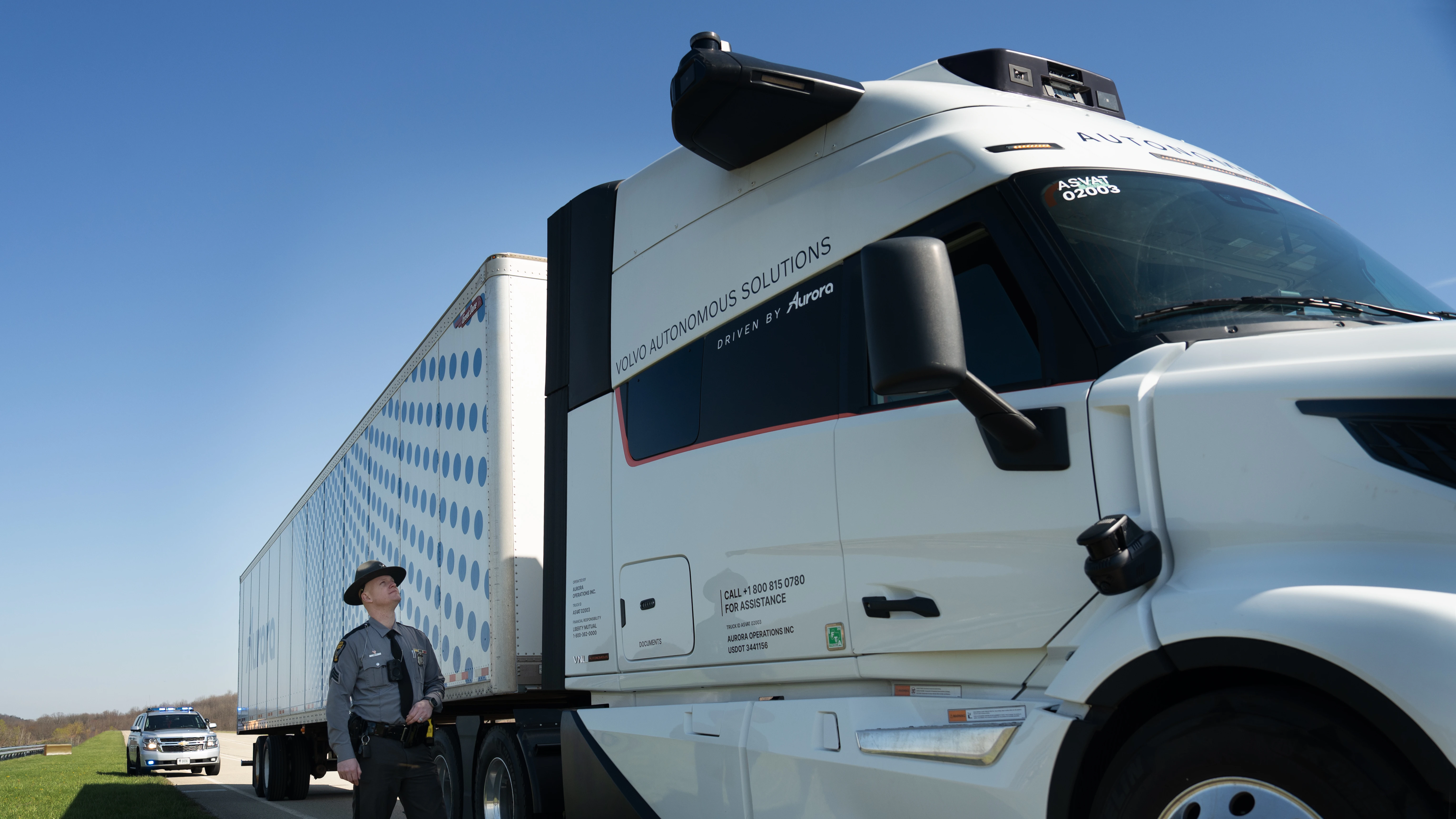
Last week, we celebrated National First Responders Day, where we honored the extraordinary service, bravery, and dedication of those who keep our communities safe. First responders run toward emergencies with an unwavering commitment to public safety. To all first responders: thank you for your service and your partnership.
Engaging Early and Often
At Aurora, our commitment to safety extends to everyone on the road, and that explicitly includes prioritizing first responders. We believe that autonomous technology should help, not hinder, the vital work of emergency personnel. That’s why we proactively partner with public safety and law enforcement agencies across the country.
These partnerships have shaped how we design and develop the Aurora Driver and comprehensive resources, including our online First Responders Guide and training materials, to ensure that those in the field understand how our technology operates and how to safely interact with our vehicles. Additionally, our teams have conducted over 50 sessions across 20 agencies and six states. Hundreds more have taken our online training modules available to anyone on our website.
Prioritized by Design
When building a safe, scalable autonomous system, emergency vehicle interactions shouldn’t be treated as edge cases or afterthoughts. Earlier this year, the National Highway Transportation Safety Administration (NHTSA) published a memo to developers to prioritize first responder interactions, joining a growing list of state and local agencies that have expressed growing frustrations around emergency scenarios involving driverless systems. Safe, reliable, and consistent behavior around emergency vehicles has been prioritized from the very beginning of our system design and captured in the Safety Case.
We test and train the Aurora Driver extensively to handle scenarios involving first responders — whether we are involved in the situation or if we need to make space for an emergency vehicle to pass by. And after accruing over 500,000 driverless miles, we’ve seen these scenarios play out as expected.
Executing a Safe Traffic Stop
The Aurora Driver autonomously hauls sand across the Permian Basin today. To prepare our operations in the region, we worked with law enforcement agencies in Odessa, Texas. In one instance, the Aurora Driver demonstrated its ability to flawlessly handle a pullover for a traffic stop. Our system recognized the Odessa law enforcement officer approaching from behind, smoothly tracking the police vehicle as it cut in behind our vehicle and shaded into the shoulder to signal a pullover instruction. The Aurora Driver performed the pullover in a timely manner without issue, coming to a complete and safe stop:
Navigating a Complex Multilane Closure at Night
Crash scenes are inherently complex, especially in dark conditions. Recently, the Aurora Driver successfully navigated a multi-lane closure at night with multiple first responders present, including an officer directing traffic with a flashlight. The Aurora Driver, with the help of a remote assistance specialist, correctly interpreted the officer’s direction before proceeding to safely and cautiously traverse the area:
Detecting a Traffic Stop 1,300 Feet Ahead at Night
Traffic stops bring elevated risk to law enforcement officers, as they need to exit their vehicle to approach the driver’s side of a stopped vehicle. That risk increases when visibility is poor. In this nighttime scenario, the system detected a stopped police car on the shoulder from approximately 1,300 feet away. Leveraging this long-range detection, the Aurora Driver initiated a smooth, early lane change to give the officer a wide berth, passing the scene safely before seamlessly returning to the far right lane.
Navigating Around a Truck Stopped in Lane
The Aurora Driver navigated around emergency vehicles responding to a Class-8 truck stopped in the middle lane of a congested freeway. As our vehicle passed the scene, we detected and nudged for a tow operator as they worked to assist the stopped vehicle.
Maintaining Space for an Active Traffic Stop
The Aurora Driver tracked a law enforcement vehicle as it approached at high speed, before entering its lane to pullover another vehicle. The Aurora Driver slowed to maintain a safe following distance as the officer and subject vehicles came to a stop on the shoulder. Then the Aurora Driver allowed traffic in the adjacent lane to pass before performing a courtesy lane change, giving the officer ample space on the shoulder.
Helping our Heroes
When driving on the highway for hours at a time, interacting with first responders is not just a possibility; it’s inevitable. The Aurora Driver is designed to make our roadways safer, not only by helping reduce annual traffic fatalities, but also by ensuring safe, predictable, and courteous behavior around the first responders who protect us every day.
To all first responders on the road today: thank you! We are proud to share the road with you.
(If you are a first responder or public safety official interested in learning more about our safety protocols and training or have feedback for us, visit our dedicated first responders page.)
Related (06)
Safety Case Framework Development and Tailoring

Driverless, Not Ruleless: Why 2026 is the Year for Federal AV Standards
Honoring First Responders: Working Together to Keep Our Roads Safe
Guiding the Industry: Aurora's Expertise Raises the Bar for Safe AV Commercial Operations

An Update on Warning Beacons